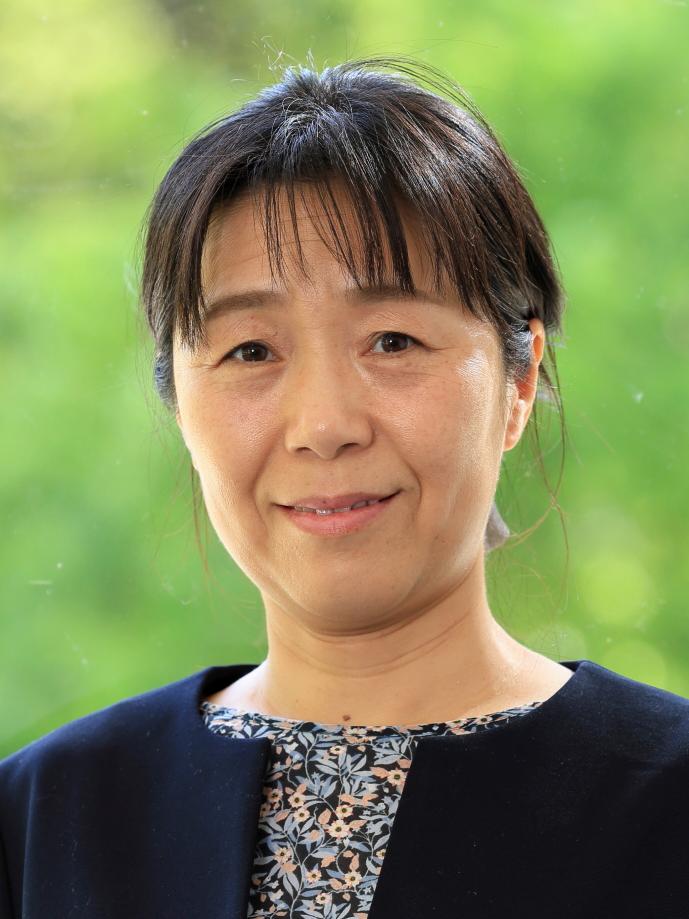
|
(Last updated : 2026-10-02 12:33:29)
|
■ Academic Background
| 1. |
2005/04~2008/03 |
〔Doctoral Course〕 Department of Systems Innovation, Division of Mathematical Science, Statistical Science Are, Graduate School, Division of Engineering Science, Osaka University, Completed, Ph.D. (Engineering) in Statistical Science |
| Period | 2005/04~2008/03 | | School Type | Postgraduate School | | Location | Japan | | School or University | Osaka University | | Department | Graduate School, Division of Engineering Science | | Course, Major | Department of Systems Innovation, Division of Mathematical Science, Statistical Science Are | | Degree Course | Doctoral | | Completion Type | Finished | | Most Recent Flag | Most Recent | | Date of Receiving Degree | 2008/03/31 | | Degree Obtained | Ph.D. (Engineering) in Statistical Science | | Approved by | Course | | Title of Thesis | Studies on Functional Data Analysis and their Applications | | Most Recent Degree Flag | Most Recent Degree | |
| 2. |
2003/04~2005/03 |
〔Master Course〕 Department of Systems Innovation, Division of Mathematical Science, Statistical Science Area, Graduate School, Division of Engineering Science, Osaka University, Completed, M.S. (Engineering) in Statistical Science |
| Period | 2003/04~2005/03 | | School Type | Postgraduate School | | Location | Japan | | School or University | Osaka University | | Department | Graduate School, Division of Engineering Science | | Course, Major | Department of Systems Innovation, Division of Mathematical Science, Statistical Science Area | | Degree Course | Master | | Completion Type | Finished | | Date of Receiving Degree | 2005/03/31 | | Degree Obtained | M.S. (Engineering) in Statistical Science | | Approved by | Course | |
| 3. |
1999/04~2003/03 |
Mathematics and Statistics, Faculty of Economics, Shiga University, Graduated, B.A. in Economics |
| Period | 1999/04~2003/03 | | School Type | University | | Location | Japan | | School or University | Shiga University | | Department | Faculty of Economics | | Course, Major | Mathematics and Statistics | | Completion Type | Graduated | | Date of Receiving Degree | 2003/03/31 | | Degree Obtained | B.A. in Economics | | Approved by | Course | |
|
Hide details for all
|
|
Display details for all
|
|
■ Professional Background
|
1. |
2025/04~ |
Associate Professor (New rank system), Division of Arts and Sciences, College of Liberal Arts, International Christian University |
| Period | 2025/04/01~ | | Employer | International Christian University | | Department | College of Liberal Arts Division of Arts and Sciences | | Position | Associate Professor (New rank system) | |
|
2. |
2023/04~2025/03 |
Associate Professor, Faculty of Science, Japan Women's University |
| Period | 2023/04~2025/03 | | Employer | Japan Women's University | | Department | Faculty of Science | | Country | Japan | | Position | Associate Professor | | Subject to Teach | Faculty of Science(Applied Mathematics (Mathematical Statistics), Applied Mathematics (Mathematical Statistics), Basic Information Processing, Exercise for Statistical Analysis, Graduation Research in Mathematics, Introduction to Statistics, Mathematical Analysis of Social Phenomena (Time Series Analysis), Practical Statistics, Statistical Analysis)
| |
|
3. |
2019/04~2023/03 |
Associate Professor, Center for Data Science, Waseda University |
| Period | 2019/04~2023/03 | | Employer | Waseda University | | Department | Center for Data Science | | Country | Japan | | Position | Associate Professor | | Subject to Teach | Center for Data Science(Hands-on Seminars on Factor Analysis and Statistical Tests, Introduction to Data Science, Statistics Literacy)
| |
|
4. |
2018/04~2019/03 |
Asistant Professor, Faculty of Science and Engineering, Waseda University |
| Period | 2018/04~2019/03 | | Employer | Waseda University | | Department | Faculty of Science and Engineering | | Country | Japan | | Position | Asistant Professor | | Subject to Teach | Faculty of Science and Engineering(Advanced Probability and Statistics, Exercise for Fundamental Mathematics (Laplace Transforms and Fourie Analysis), Financial Econometrics (Time Series Analysis), Foundations of Analysis (Measure Theory and Lebesgue Integral), Introduction to Probability and Statistics, Ordinary Differential Equations, Probability and Statistics)
| |
|
5. |
2014/04~2018/03 |
Assistant Professor, Faculty of Science and Engineering, Waseda University |
| Period | 2014/04~2018/03 | | Employer | Waseda University | | Department | Faculty of Science and Engineering | | Country | Japan | | Position | Assistant Professor | | Subject to Teach | Faculty of Science and Engineering(Advanced Probability and Statistics, Exercise for Fundamental Mathematics (Laplace Transforms and Fourie Analysis), Financial Econometrics (Time Series Analysis), Foundations of Analysis (Measure Theory and Lebesgue Integral), Introduction to Probability and Statistics, Ordinary Differential Equations, Probability and Statistics)
| |
|
6. |
2013/04~2014/03 |
Part-time Lecturer, University Faculty of Science and Engineering, Waseda |
| Period | 2013/04~2014/03 | | Employer | Waseda | | Department | University Faculty of Science and Engineering | | Country | Japan | | Position | Part-time Lecturer | |
|
7. |
2010/04~2014/03 |
Project Researcher, Research Organization of Information and Systems, Transdisciplinary Research Integration Center |
| Period | 2010/04~2014/03 | | Employer | Research Organization of Information and Systems, Transdisciplinary Research Integration Center | | Country | Japan | | Position | Project Researcher | |
|
8. |
2008/04~2010/03 |
Project Researcher, Institute of Statistical Mathematics |
| Period | 2008/04~2010/03 | | Employer | Institute of Statistical Mathematics | | Country | Japan | | Position | Project Researcher | |
|
Hide details for all
|
|
Display details for all
|
|
Display 5 items
|
|
Display all(8)
|
|
■ Present Specialized Fields
|
■ Profile
| Xiaoling Dou is an Associate Professor in the Department of Natural Sciences. With a specialization in Statistics, her research focuses on Functional Data Analysis, Copulas, and Time Series Analysis, along with various other topics in mathematical statistics and their applications. |
|
■ Books and Articles
|
1. |
Article |
Abrupt changes in day-to-day temperature variability over China around 2012 Scientific Reports (Collaboration) 2026/08 |
| Language | English | | Publication Date | 2026/08 | | Type | Research Paper | | Peer Review | With peer review | | Title | Abrupt changes in day-to-day temperature variability over China around 2012 | | Contribution Type | Joint Work | | Journal | Scientific Reports | | Journal Type | Another Country | | Publisher | Springer Nature | | International coauthorship | International coauthorship | | Author and coauthor | Xiangrui Zhi, Xiaoling Dou, Shuhe Lei | |
|
2. |
Article |
EM estimation of the B-spline copula with penalized pseudo-likelihood functions Statistical Papers 66(30) (Collaboration) 2025/01 |
| Language | English | | Publication Date | 2025/01 | | Type | Research Paper | | Peer Review | With peer review | | Title | EM estimation of the B-spline copula with penalized pseudo-likelihood functions | | Contribution Type | Joint Work | | Journal | Statistical Papers | | Journal Type | Another Country | | Publisher | Springer Nature | | Volume, Issue, Pages | 66(30) | | Authorship | Lead author,Corresponding author | | International coauthorship | International coauthorship | | Author and coauthor | Xiaoling Dou, Satoshi Kuriki, Gwo Dong Lin, Donald Richards | | Details | The B-spline copula function is defined by a linear combination of elements of the normalized B-spline basis. We develop a modified EM algorithm, to maximize the penalized pseudo-likelihood function, wherein we use the smoothly clipped absolute deviation (SCAD) penalty function for the penalization term. We conduct simulation studies to demonstrate the stability of the proposed numerical procedure, show that penalization yields estimates with smaller mean-square errors when the true parameter matrix is sparse, and provide methods for determining tuning parameters and for model selection. We analyze as an example a data set consisting of birth and death rates from 237 countries, available at the website, “Our World in Data,” and we estimate the marginal density and distribution functions of those rates together with all parameters of our B-spline copula model. | |
|
3. |
Article |
Bell numbers in Matsunaga's and Arima's Genjiko combinatorics: Modern perspectives and local limit theorems The Electronic Journal of Combinatorics 29(2) (Collaboration) 2022/04 |
| Language | English | | Publication Date | 2022/04 | | Type | Research Paper | | Peer Review | With peer review | | Title | Bell numbers in Matsunaga's and Arima's Genjiko combinatorics: Modern perspectives and local limit theorems | | Contribution Type | Joint Work | | Journal | The Electronic Journal of Combinatorics | | Journal Type | Another Country | | Volume, Issue, Pages | 29(2) | | Authorship | Lead author | | International coauthorship | International coauthorship | | Author and coauthor | Xiaoling Dou, Hsien-Kuei Hwang, Chong-Yi Li | | Details | We examine and clarify in detail the contributions of Yoshisuke Matsunaga (1694?–1744) to the computation of Bell numbers in the eighteenth century (in the Edo period), providing modern perspectives to some unknown materials that are by far the earliest in the history of Bell numbers. Later clarification and developments by Yoriyuki Arima (1714–1783), and several new results such as the asymptotic distributions (notably the corresponding local limit theorems) of a few closely related sequences are also given. | |
|
4. |
Article |
Causality for CHARN models Scientiae Mathematicae Japaonicae 85,pp.59-74 (Single) 2021/06 |
| Language | English | | Publication Date | 2021/06 | | Type | Research Paper | | Peer Review | With peer review | | Title | Causality for CHARN models | | Contribution Type | Single Work | | Journal | Scientiae Mathematicae Japaonicae | | Journal Type | Another Country | | Volume, Issue, Pages | 85,pp.59-74 | | Total page number | 16 | | Authorship | Lead author,Last author,Corresponding author | | Author and coauthor | Xiaoling Dou | |
|
5. |
Article |
Dependence properties of B-spline copulas Sankhya A 83,pp.283-311 (Collaboration) 2021/02 |
| Language | English | | Publication Date | 2021/02 | | Type | Research Paper | | Peer Review | With peer review | | Title | Dependence properties of B-spline copulas | | Contribution Type | Joint Work | | Journal | Sankhya A | | Journal Type | Another Country | | Volume, Issue, Pages | 83,pp.283-311 | | Authorship | Lead author,Corresponding author | | International coauthorship | International coauthorship | | Author and coauthor | Xiaoling Dou, Satoshi Kuriki, Gwo Dong Lin, Donald Richards | | Details | We construct by using B-spline functions a class of copulas that includes the Bernstein copulas arising in Baker’s distributions. The range of correlation of the B-spline copulas is examined, and the Fréchet–Hoeffding upper bound is proved to be attained when the number of B-spline functions goes to infinity. As the B-spline functions are well-known to be an order-complete weak Tchebycheff system from which the property of total positivity of any order follows for the maximum correlation case, the results given here extend classical results for the Bernstein copulas. In addition, we derive in terms of the Stirling numbers of the second kind an explicit formula for the moments of the related B-spline functions on the right half-line. | |
|
6. |
Article |
The bivariate lack-of-memory distributions Sankhya A 81,pp.273-297 (Collaboration) 2019/12 |
| Language | English | | Publication Date | 2019/12 | | Type | Research Paper | | Peer Review | With peer review | | Title | The bivariate lack-of-memory distributions | | Contribution Type | Joint Work | | Journal | Sankhya A | | Journal Type | Another Country | | Publisher | Springer | | Volume, Issue, Pages | 81,pp.273-297 | | International coauthorship | International coauthorship | | Author and coauthor | Gwo Dong Lin, Xiaoling Dou, Satoshi Kuriki | | Details | We treat all the bivariate lack-of-memory (BLM) distributions in a unified approach and develop some new general properties of the BLM distributions, including joint moment generating function, product moments, and dependence structure. Necessary and sufficient conditions for the survival functions of BLM distributions to be totally positive of order two are given. Some previous results about specific BLM distributions are improved. In particular, we show that both the Marshall–Olkin survival copula and survival function are totally positive of all orders, regardless of parameters. Besides, we point out that Slepian’s inequality also holds true for BLM distributions. | |
|
7. |
Article |
An investigation of a generalized least squares estimator for non-linear time series model Scientiae Mathematicae Japonicae 82,pp.29-44 (Single) 2019/07 |
| Language | English | | Publication Date | 2019/07 | | Type | Research Paper | | Peer Review | With peer review | | Title | An investigation of a generalized least squares estimator for non-linear time series model | | Contribution Type | Single Work | | Journal | Scientiae Mathematicae Japonicae | | Journal Type | Another Country | | Volume, Issue, Pages | 82,pp.29-44 | | Authorship | Lead author,Last author,Corresponding author | | Author and coauthor | Xiaoling Dou | | Details | Ochi(1983) proposed an estimator for the autoregressive coefficient of the first-order autoregressive model (AR(1)) by using two constants for the end points of the process. Classical estimators for AR(1), such as the least squares estimator, Burg's estimator, and Yule- Walker estimator are obtained as special cases by choice of the constants in Ochi's estimator. By writing the first-order autoregressive conditional heteroskedastic model, ARCH(1), in a form similar to that of AR(1), we extend Ochi's estimator to ARCH(1) models. This allows introducing analogues of the least squares estimator, Burg's estimator and Yule- Walker estimator, and we compare the relations of these with Ochi's estimator for ARCH(1) models. We then provide a simulation for AR(1) models and examine the performance of Ochi's estimator. Also, we simulate Ochi's estimator for ARCH(1) with different parameter values and sample sizes. | |
|
8. |
Article |
Functional clustering of mouse ultrasonic vocalization data PLOS ONE 13(5),pp.e0196834 (Collaboration) 2018/05 |
| Language | English | | Publication Date | 2018/05 | | Type | Research Paper | | Peer Review | With peer review | | Title | Functional clustering of mouse ultrasonic vocalization data | | Contribution Type | Joint Work | | Journal | PLOS ONE | | Journal Type | Another Country | | Volume, Issue, Pages | 13(5),pp.e0196834 | | Authorship | Lead author,Corresponding author | | Author and coauthor | Xiaoling Dou, Shingo Shirahata, Hiroki Sugimoto | | Details | Mouse ultrasonic vocalizations (USVs) are studied in many fields of science. However, various noise and varied USV patterns in observed signals make complete automatic analysis difficult. We improve several methods to reduce noise, detect USV calls and automatically cluster USV calls. After reduction of noise and detection of USV calls, we consider USV calls as functional data and characterize them as USV functions with B-spline basis functions. For discontinuous USV calls, breakpoints in the USV functions are defined using multiple knots in the construction of the B-spline basis functions, and a hierarchical method is used to cluster the USV functions by shape. We finally show the performance of the proposed methods with USV data recorded for laboratory mice. | |
|
9. |
Article |
Testing for Granger causality by use of Box-Cox transformations ASTE Special Issue on the “Financial & Pension Mathematical Science” pp.3-17 (Collaboration) 2016/03 |
| Language | Japanese | | Publication Date | 2016/03 | | Type | Research Paper | | Peer Review | With peer review | | Title | Testing for Granger causality by use of Box-Cox transformations | | Contribution Type | Joint Work | | Journal | ASTE Special Issue on the “Financial & Pension Mathematical Science” | | Journal Type | Japan | | Volume, Issue, Pages | pp.3-17 | | Authorship | Lead author,Corresponding author | | Author and coauthor | Ryunosuke Koike, Xiaoling Dou, Masanobu Taniguchi, Yujie Xue | |
|
10. |
Article |
EM algorithms for estimating the Bernstein copula Computational Statistics & Data Analysis 93,pp.228-245 (Collaboration) 2016/01 |
| Language | English | | Publication Date | 2016/01 | | Type | Research Paper | | Peer Review | With peer review | | Title | EM algorithms for estimating the Bernstein copula | | Contribution Type | Joint Work | | Journal | Computational Statistics & Data Analysis | | Journal Type | Another Country | | Publisher | ELSEVIER | | Volume, Issue, Pages | 93,pp.228-245 | | Authorship | Lead author,Corresponding author | | International coauthorship | International coauthorship | | Author and coauthor | Xiaoling Dou, Satoshi Kuriki, Gwo Dong Lin, and Donald Richards | | Details | A method that uses order statistics to construct multivariate distributions with fixed marginals and which utilizes a representation of the Bernstein copula in terms of a finite mixture distribution is proposed. Expectation–maximization (EM) algorithms to estimate the Bernstein copula are proposed, and a local convergence property is proved. Moreover, asymptotic properties of the proposed semiparametric estimators are provided. Illustrative examples are presented using three real data sets and a 3-dimensional simulated data set. These studies show that the Bernstein copula is able to represent various distributions flexibly and that the proposed EM algorithms work well for such data. | |
|
11. |
Article |
Noise reduction and classification of mouse ultrasonic vocalization data ASTE Special Issue on the “Financial & Pension Mathematical Science” 12,pp.71-79 (Collaboration) 2015/03 |
| Language | English | | Publication Date | 2015/03 | | Type | Research Paper | | Peer Review | With peer review | | Title | Noise reduction and classification of mouse ultrasonic vocalization data | | Contribution Type | Joint Work | | Journal | ASTE Special Issue on the “Financial & Pension Mathematical Science” | | Journal Type | Japan | | Volume, Issue, Pages | 12,pp.71-79 | | Authorship | Lead author,Corresponding author | | Author and coauthor | Xiaoling Dou, Shingo Shirahata, Sugimoto Hiroki, Tsuyoshi Koide | |
|
12. |
Article |
Recent developments on the construction of bivariate distributions with fixed marginals Journal of Statistical Distributions and Applications 1(14) (Collaboration) 2014/06 |
| Language | English | | Publication Date | 2014/06 | | Type | Research Paper | | Peer Review | With peer review | | Title | Recent developments on the construction of bivariate distributions with fixed marginals | | Contribution Type | Joint Work | | Journal | Journal of Statistical Distributions and Applications | | Journal Type | Another Country | | Publisher | Springer Nature | | Volume, Issue, Pages | 1(14) | | International coauthorship | International coauthorship | | Author and coauthor | Gwo Dong Lin, Xiaoling Dou, Satoshi Kuriki, Jin-Sheng Huang | | Details | Constructing a bivariate distribution with specific marginals and correlation has been a challenging problem since 1930s. In this survey we shall focus on the recent developments on the FGM-related distributions, including Sarmanov and Lee’s distributions, Baker’s distributions and Bayramoglu’s distributions. This complements the most recent works of (i) the review by Sarabia and Gómez-Déniz (2008, SORT) and (ii) the monograph by Balakrishnan and Lai (2009, Springer). Some new results are provided. | |
|
13. |
Article |
Influence analysis in quantitative trait loci detection Biometrical Journal 56(4),pp.697-719 (Collaboration) 2014/04 |
| Language | English | | Publication Date | 2014/04 | | Type | Research Paper | | Peer Review | With peer review | | Title | Influence analysis in quantitative trait loci detection | | Contribution Type | Joint Work | | Journal | Biometrical Journal | | Journal Type | Another Country | | Volume, Issue, Pages | 56(4),pp.697-719 | | Authorship | Lead author,Corresponding author | | Author and coauthor | Xiaoling Dou, Satoshi Kuriki, Akiteru Maeno, Toyoyuki Takada, Toshihiko Shiroishi | | Details | This paper presents systematic methods for the detection of influential individuals that affect the log odds (LOD) score curve. We derive general formulas of influence functions for profile likelihoods and introduce them into two standard quantitative trait locus detection methods—the interval mapping method and single marker analysis. Besides influence analysis on specific LOD scores, we also develop influence analysis methods on the shape of the LOD score curves. A simulation-based method is proposed to assess the significance of the influence of the individuals. These methods are shown useful in the influence analysis of a real dataset of an experimental population from an F2 mouse cross. By receiver operating characteristic analysis, we confirm that the proposed methods show better performance than existing diagnostics. | | URL for researchmap | https://doi.org/10.1002/bimj.201200178 | |
|
14. |
Article |
Dependence structures and asymptotic properties of Baker's distributions with fixed marginals Journal of Statistical Planning and Inference 143(8),pp.1343-1354 (Collaboration) 2013/03 |
| Language | English | | Publication Date | 2013/03 | | Type | Research Paper | | Peer Review | With peer review | | Title | Dependence structures and asymptotic properties of Baker's distributions with fixed marginals | | Contribution Type | Joint Work | | Journal | Journal of Statistical Planning and Inference | | Journal Type | Another Country | | Publisher | ELSEVIER | | Volume, Issue, Pages | 143(8),pp.1343-1354 | | Authorship | Lead author,Corresponding author | | International coauthorship | International coauthorship | | Author and coauthor | Xiaoling Dou, Satoshi Kuriki, Gwo Dong Lin | | Details | We investigate the properties of Baker's (2008) bivariate distributions with fixed marginals and their multivariate extensions. The properties include the weak convergence to the Fréchet–Hoeffding upper bound, the product-moment convergence, as well as the dependence structures TP2 (totally positive of order 2), or MTP2 (multivariate TP2). In proving the weak convergence, a generalized local limit theorem for binomial distribution is provided. | |
|
15. |
Article |
Dependence structure of bivariate order statistics with applications to Bayramouglu's distributions Journal of Multivariate Analysis 114,pp.201-208 (Collaboration) 2013/02 |
| Language | English | | Publication Date | 2013/02 | | Type | Research Paper | | Peer Review | With peer review | | Title | Dependence structure of bivariate order statistics with applications to Bayramouglu's distributions | | Contribution Type | Joint Work | | Journal | Journal of Multivariate Analysis | | Journal Type | Another Country | | Publisher | ELSEVIER | | Volume, Issue, Pages | 114,pp.201-208 | | International coauthorship | International coauthorship | | Author and coauthor | J. S. Huang, Xiaoling Dou, Satoshi Kuriki, G. D. Lin | |
|
16. |
Article |
Comparisons of B-spline procedures with kernel procedures in estimating regression functions and their derivatives Journal of the Japanese Society of Computational Statistics 22,pp.57-77 (Collaboration) 2009/01 |
| Language | English | | Publication Date | 2009/01 | | Type | Research Paper | | Peer Review | With peer review | | Title | Comparisons of B-spline procedures with kernel procedures in estimating regression functions and their derivatives | | Contribution Type | Joint Work | | Journal | Journal of the Japanese Society of Computational Statistics | | Journal Type | Japan | | Volume, Issue, Pages | 22,pp.57-77 | | Authorship | Lead author,Corresponding author | | Author and coauthor | Xiaoling Dou, Shingo Shirahata | | Details | There are several methods to estimate regression functions and their derivatives. Among them, B-spline procedures and kernel procedures are known to be useful. However, at present, it is not determined which procedure is better than the others. In this paper, we investigate the performance of the procedures by computer simulations. | |
|
17. |
Article |
Discriminant analysis for functional data: linear methods and functional subspace methods Bulletin of the Computational Statistics of Japan pp.13-30 (Collaboration) 2007/07 |
| Language | Japanese | | Publication Date | 2007/07 | | Type | Research Paper | | Peer Review | With peer review | | Title | Discriminant analysis for functional data: linear methods and functional subspace methods | | Contribution Type | Joint Work | | Journal | Bulletin of the Computational Statistics of Japan | | Journal Type | Japan | | Volume, Issue, Pages | pp.13-30 | | Authorship | Lead author,Corresponding author | | Author and coauthor | Xiaoling Dou, Shingo Shirahata, Wataru Sakamoto | | Details | In discriminant analysis of functional data, several linear methods have been proposed, such as, filtering method, penalized discriminant analysis and functional linear discriminant analysis. However, if the size of training data is small or if it can not be assumed that the data in each class are from multivariate normal populations with equal covariance matrices, there is no guarantee that linear methods are always available.
To solve this problem, we propose nonlinear discriminant analysis methods called Functional Subspace Methods (FSMs) based on functional principal component expansion. FSMs include Functional Subspace Method and Functional CLAFIC Method. These procedures do not require any knowledge on the underlying distributions of populations, but linear discriminant analysis methods do. Furthermore, our methods can be carried out more rapidly than the traditional subspace methods, because they can be computed with lower dimensions. To show that the functional subspace methods are effective, we compare them with the filtering method. As a result, the functional subspace methods give good discrimination. Particularly, when the size of training data is small they can give more stable results than the filtering method. | |
|
Hide details for all
|
|
Display details for all
|
|
Display 5 items
|
|
Display all(17)
|
|
■ Academic Conference Presentation
| 1. |
2026/08/04 |
Model selection for a smooth empirical beta copula |
| Date | 2026/08/04 | | Presentation Theme | Model selection for a smooth empirical beta copula | | Promoters | American Statistical Association | | Conference Type | International | | Presentation Type | Speech (General) | | Contribution Type | Individual | | Country | United States | | Venue | Boston | | Holding period | 2026/08/01~2026/08/06 | | Details | A copula is a multivariate probability distribution function whose marginal probability distribution of each random variable is Unif(0,1). Copulas are useful in describing the dependence structure of multivariate distributions. So far, many copulas have been proposed and applied in various fields. The empirical beta copula is defined by using ranks of data and the beta distribution. It can be considered a non-parametric method for describing the dependence structure of multivariate data. Since no parameter is needed to estimate in the copula, this copula is very easy to use. However, since the method uses all ranks of the data, when the sample size is large, the computation of the gamma functions becomes difficult. To enhance the utility of this copula, we consider to parameterize it by separating the data into cells of K by K grid and investigating the method of selecting K. This would make the computation easier and provide a smoother copula density function. | |
| 2. |
2025/12/18 |
B-Spline Copula and Its Estimation (Joint 2025) |
| Date | 2025/12/18 | | Presentation Theme | B-Spline Copula and Its Estimation | | Conference | Joint 2025 | | Promoters | Academia Sinica | | Conference Type | International | | Presentation Type | Speech (Invitation/Special) | | Contribution Type | Individual | | Invited | Invited | | International coauthorship | International coauthorship | | Country | Taiwan | | Venue | Taipei | | Holding period | 2025/12/17~2025/12/20 | | Details | The B-spline copula is defined by a linear combination of elements of the normalized B-spline
basis functions. The B-spline copula includes the Bernstein copulas as a special case. We
examine the dependence properties of the B-spline copula and develop an EM algorithm to
estimate the parameters of the copula. The EM algorithm is designed to maximize the penalized
pseudo-likelihood function, wherein we use the smoothly clipped absolute deviation (SCAD)
penalty function for the penalization term. We conduct simulation studies to demonstrate the
stability of the proposed numerical procedure, show that penalization yields estimates with
smaller mean-square errors when the true parameter matrix is sparse, and provide methods for
determining tuning parameters and for model selection. | |
| 3. |
2025/08/21 |
A Newton-Raphson method for estimating the B-spline copula (EcoSta 2025) |
| Date | 2025/08/21 | | Presentation Theme | A Newton-Raphson method for estimating the B-spline copula | | Conference | EcoSta 2025 | | Conference Type | International | | Presentation Type | Speech (Invitation/Special) | | Contribution Type | Individual | | Invited | Invited | | Country | Japan | | Venue | Waseda University | |
|
Hide details for all
|
|
Display details for all
|
|
■ Lectures
|
■ Academic Society Memberships
|
■ Educational Achievements
| ● Practice example of education method |
| 1. |
2014/04/01~2025/03/31 |
Active learning |
| Type | Practical Example of Education Technique | | Period | 2014/04/01~2025/03/31 | | Item | Active learning | | Details | To make my lectures easy to understand for all students (both arts and sciences), I always try to teach in easy English and explain clearly using examples and figures. I also make lecture notes for students for their systemic understanding of the courses. In class, I often ask students questions so that I can know how much they understand and then I can adjust the pace of teaching appropriately. I also encourage them to discuss and solve problems together in class. This is also an effective way for me to encourage students to participate. Particularly, in the courses of Data Science of Time Series, Statistics Literacy α, Financial Econometrics and the hands-on seminars, I give students examples and exercises of real data analysis. This helps them to understand how Data Science works in the real world. | |
| ● Made textbook and teaching material |
| 1. |
2013/04/01~2019/03/31 |
Oridinary Differential Equations |
| Type | Prepared Textbook and Other Teaching Materials | | Period | 2013/04/01~2019/03/31 | | Item | Oridinary Differential Equations | | Details | Textbook files, Exercises and Exams | |
| 2. |
2013/09/01~2019/03/31 |
Probability and Statistics |
| Type | Prepared Textbook and Other Teaching Materials | | Period | 2013/09/01~2019/03/31 | | Item | Probability and Statistics | | Details | Textbook files, Exercises and Exams | |
| 3. |
2019/04/01~2023/03/31 |
Introduction to Data Science α |
| Type | Prepared Textbook and Other Teaching Materials | | Period | 2019/04/01~2023/03/31 | | Item | Introduction to Data Science α | | Details | Video, Slides, Exercises and Exams (for weeks 1, 3, 5, 7) | |
| 4. |
2019/04/01~2023/03/31 |
Statistics Literacy α |
| Type | Prepared Textbook and Other Teaching Materials | | Period | 2019/04/01~2023/03/31 | | Item | Statistics Literacy α | | Details | Textbook files, Videos, Slides, Exercises and Exams | |
| 5. |
2019/04/01~2023/03/31 |
Statistics Literacy γ |
| Type | Prepared Textbook and Other Teaching Materials | | Period | 2019/04/01~2023/03/31 | | Item | Statistics Literacy γ | | Details | Textbook files, Videos, Slides, Exercises and Exams (for weeks 1, 2, 3) | |
| 6. |
2020/09/01~2023/03/31 |
Time Series on Data Science |
| Type | Prepared Textbook and Other Teaching Materials | | Period | 2020/09/01~2023/03/31 | | Item | Time Series on Data Science | | Details | Slides, Exercises and Final exam | |
| 7. |
2023/04/01~2025/03/31 |
Analysis for Real World (Time Series Analysis) |
| Type | Prepared Textbook and Other Teaching Materials | | Period | 2023/04/01~2025/03/31 | | Item | Analysis for Real World (Time Series Analysis) | |
| 8. |
2023/04/01~2025/03/31 |
Information Statistics (Statistical Inference with R) |
| Type | Prepared Textbook and Other Teaching Materials | | Period | 2023/04/01~2025/03/31 | | Item | Information Statistics (Statistical Inference with R) | |
| 9. |
2023/04/01~2025/03/31 |
Introduction to Statistics |
| Type | Prepared Textbook and Other Teaching Materials | | Period | 2023/04/01~2025/03/31 | | Item | Introduction to Statistics | |
| 10. |
2023/04/01~2025/03/31 |
Practical Statistics |
| Type | Prepared Textbook and Other Teaching Materials | | Period | 2023/04/01~2025/03/31 | | Item | Practical Statistics | |
| 11. |
2023/04/01~2025/03/31 |
Statistical Analysis |
| Type | Prepared Textbook and Other Teaching Materials | | Period | 2023/04/01~2025/03/31 | | Item | Statistical Analysis | |
| 12. |
2025/09/01~ |
Introduction to Probability and Statistics |
| Type | Prepared Textbook and Other Teaching Materials | | Period | 2025/09/01~ | | Item | Introduction to Probability and Statistics | |
| 13. |
2025/09/01~2025/11/30 |
Linear Algebra I |
| Type | Prepared Textbook and Other Teaching Materials | | Period | 2025/09/01~2025/11/30 | | Item | Linear Algebra I | |
| 14. |
2025/12/01~2026/02/28 |
Calculus I |
| Type | Prepared Textbook and Other Teaching Materials | | Period | 2025/12/01~2026/02/28 | | Item | Calculus I | | Details | 講義資料、試験問題 | |
| ● Evaluation such as universities concerning teacher's concerned educational ability |
| 1. |
2018/04/01~2019/03/31 |
WASEDA e-Teaching Award 2019 (Good Practice) |
| Type | University’s Evaluation on Teaching Capability of This Person | | Period | 2018/04/01~2019/03/31 | | Item | WASEDA e-Teaching Award 2019 (Good Practice) | | Details | Courses:
(1) Advanced Probability and Statistics
(2) Ordinary Differential Equations
(3) Exercise for Fundamental Mathematics | |
| ● Matter that should be mentioned specially in others educational activity |
| 1. |
2026/01/26~2026/01/26 |
Guest Lecture for BIO101 |
| Type | Other Special Instructions about Teaching Activities | | Period | 2026/01/26~2026/01/26 | | Item | Guest Lecture for BIO101 | | Details | The Role of Statistics in Biology
–Regression Analysis & Functional Data Analysis– | |
| 2. |
2026/05/18~2026/05/18 |
Guest Lecture for QALL402 Field Research and Professional Learning |
| Type | Other Special Instructions about Teaching Activities | | Period | 2026/05/18~2026/05/18 | | Item | Guest Lecture for QALL402 Field Research and Professional Learning | | Details | An Introduction to Statistics | |
|
Hide details for all
|
|
Display details for all
|
|
Display 5 items
|
|
Display all(18)
|
|
■ Course Titles
| 1. |
Advanced Seminar in Mathematics I |
| Subject Name | Advanced Seminar in Mathematics I | | Time in Year | 1st Half of the Year | | Degree Type | Undergraduate | | No. of Units Allocated | 2Units | |
| 2. |
Advanced Studies in Mathematical Science I |
| Subject Name | Advanced Studies in Mathematical Science I | | Time in Year | 1st Half of the Year | | Degree Type | Doctoral Program (1st Semester) | | No. of Units Allocated | 2Units | |
| 3. |
N2: Ideas of Data Science |
| Subject Name | N2: Ideas of Data Science | | Time in Year | 1st Half of the Year | | Degree Type | Undergraduate | | No. of Units Allocated | 2Units | |
| 4. |
Research I |
| Subject Name | Research I | | Time in Year | 1st Half of the Year | | Degree Type | Doctoral Program (1st Semester) | | No. of Units Allocated | 2Units | |
| 5. |
Senior Thesis |
| Subject Name | Senior Thesis | | Time in Year | 1st Half of the Year | | Degree Type | Undergraduate | | No. of Units Allocated | 9Units | |
|
Hide details for all
|
|
Display details for all
|
|
■ Teaching Experience
| 1. |
Exercise for Fundamental Mathematics(Waseda University) |
| Period | 2014/04~2019/03 | | Level | Undergraduate(Specialized) | | Subject | Exercise for Fundamental Mathematics | | Institution name | Waseda University | | Description | Laplace Transforms and Fourier Analysis | |
| 2. |
Financial Econometrics(Waseda University) |
| Period | 2014/04~2018/03 | | Level | PostgGraduate | | Subject | Financial Econometrics | | Institution name | Waseda University | | Description | Time Series Analysis | |
| 3. |
Foundations of Analysis(Waseda University) |
| Period | 2014/04~2019/03 | | Level | Undergraduate(Specialized) | | Subject | Foundations of Analysis | | Institution name | Waseda University | | Description | Measure Theory and Lebesgue Integral | |
| 4. |
Introduction to Data Science α(Waseda University) |
| Period | 2019/04~2023/03 | | Level | Undergraduate(liberal arts) | | Subject | Introduction to Data Science α | | Institution name | Waseda University | |
| 5. |
Introduction to Probability and Statistics(Waseda University) |
| Period | 2018/04~2019/03 | | Level | Undergraduate(Specialized) | | Subject | Introduction to Probability and Statistics | | Institution name | Waseda University | |
| 6. |
Ordinary Differential Equations(Waseda University) |
| Period | 2013/04~2019/03 | | Level | Undergraduate(Specialized) | | Subject | Ordinary Differential Equations | | Institution name | Waseda University | |
| 7. |
Probability and Statistics(Waseda University) |
| Period | 2013/09~2019/03 | | Level | Undergraduate(Specialized) | | Subject | Probability and Statistics | | Institution name | Waseda University | |
| 8. |
Special Seminar Course “Measure Theory and Lebesgue Integration II”(Waseda University) |
| Period | 2015/09~2016/03 | | Level | Undergraduate(Specialized) | | Subject | Special Seminar Course “Measure Theory and Lebesgue Integration II” | | Institution name | Waseda University | |
| 9. |
Statistics Literacy α(Waseda University) |
| Period | 2019/04~2023/03 | | Level | Undergraduate(liberal arts) | | Subject | Statistics Literacy α | | Institution name | Waseda University | |
| 10. |
Statistics Literacy γ(Waseda University) |
| Period | 2019/04~2023/03 | | Level | Undergraduate(liberal arts) | | Subject | Statistics Literacy γ | | Institution name | Waseda University | |
| 11. |
Data Science on Time Series(Waseda University) |
| Period | 2020/09~2023/03 | | Level | Undergraduate(liberal arts) | | Subject | Data Science on Time Series | | Institution name | Waseda University | |
| 12. |
Statistics Literacy α(Waseda University) |
| Period | 2019/04~2023/03 | | Level | Undergraduate(liberal arts) | | Subject | Statistics Literacy α | | Institution name | Waseda University | |
| 13. |
Statistics Literacy β(Waseda University) |
| Period | 2019/04~2023/03 | | Level | Undergraduate(liberal arts) | | Subject | Statistics Literacy β | | Institution name | Waseda University | |
| 14. |
Statistics Literacy γ(Waseda University) |
| Period | 2019/04~2023/03 | | Level | Undergraduate(liberal arts) | | Subject | Statistics Literacy γ | | Institution name | Waseda University | |
| 15. |
Statistics Literacy δ(Waseda University) |
| Period | 2019/04~2023/03 | | Level | Undergraduate(liberal arts) | | Subject | Statistics Literacy δ | | Institution name | Waseda University | |
| 16. |
Computer Literacy(Japan Women's University) |
| Period | 2023/04~2025/03 | | Level | Undergraduate(liberal arts) | | Subject | Computer Literacy | | Institution name | Japan Women's University | |
| 17. |
Applied Mathematical Science I (Probability Theory)(Japan Women's University) |
| Period | 2023/04~2024/03 | | Level | PostgGraduate | | Subject | Applied Mathematical Science I (Probability Theory) | | Institution name | Japan Women's University | |
| 18. |
Information Statistics (Statistical Inference with R)(Japan Women's University) |
| Period | 2023/04~2025/03 | | Level | Undergraduate(Specialized) | | Subject | Information Statistics (Statistical Inference with R) | | Institution name | Japan Women's University | |
| 19. |
Mathematics Seminar(Japan Women's University) |
| Period | 2023/04~2025/03 | | Level | Undergraduate(Specialized) | | Subject | Mathematics Seminar | | Institution name | Japan Women's University | |
| 20. |
Graduation Study of Mathematics (I, II) (Multivariate analysis and their applications for 5 undergraduate students)(Japan Women's University) |
| Period | 2023/04~2025/03 | | Level | Undergraduate(Specialized) | | Subject | Graduation Study of Mathematics (I, II) (Multivariate analysis and their applications for 5 undergraduate students) | | Institution name | Japan Women's University | |
| 21. |
Advanced Study of Mathematics (I, II) (Multivariate analysis and their applications for 5 undergraduate students)(Japan Women's University) |
| Period | 2023/04~2025/03 | | Level | Undergraduate(Specialized) | | Subject | Advanced Study of Mathematics (I, II) (Multivariate analysis and their applications for 5 undergraduate students) | | Institution name | Japan Women's University | |
| 22. |
Topics in Mathematics I (Introduction to Statistics)(Japan Women's University) |
| Period | 2024/04~2025/03 | | Level | Undergraduate(Specialized) | | Subject | Topics in Mathematics I (Introduction to Statistics) | | Institution name | Japan Women's University | |
| 23. |
Mathematical Statistics(Japan Women's University) |
| Period | 2023/04~2025/03 | | Level | Undergraduate(Specialized) | | Subject | Mathematical Statistics | | Institution name | Japan Women's University | |
| 24. |
Practical Statistics(Japan Women's University) |
| Period | 2023/04~2025/03 | | Level | Undergraduate(liberal arts) | | Subject | Practical Statistics | | Institution name | Japan Women's University | |
| 25. |
Analysis for Real World (Time Series Analysis)(Japan Women's University) |
| Period | 2023/04~2025/03 | | Level | Undergraduate(Specialized) | | Subject | Analysis for Real World (Time Series Analysis) | | Institution name | Japan Women's University | |
| 26. |
Introduction to Statistics(Japan Women's University) |
| Period | 2023/04~2025/03 | | Level | Undergraduate(liberal arts) | | Subject | Introduction to Statistics | | Institution name | Japan Women's University | |
| 27. |
Statistical Structure I (Inference Theory)(Japan Women's University) |
| Period | 2024/04~2025/03 | | Level | PostgGraduate | | Subject | Statistical Structure I (Inference Theory) | | Institution name | Japan Women's University | |
| 28. |
Statistical Analysis (Probability and Statistics)(Japan Women's University) |
| Period | 2023/04~2025/03 | | Level | Undergraduate(Specialized) | | Subject | Statistical Analysis (Probability and Statistics) | | Institution name | Japan Women's University | |
| 29. |
Problem Session in Statistical Analysis(Japan Women's University) |
| Period | 2023/04~2025/03 | | Level | Undergraduate(Specialized) | | Subject | Problem Session in Statistical Analysis | | Institution name | Japan Women's University | |
| 30. |
Advanced Seminar in Mathematics I(国際基督教大学) |
| Period | 2025/04~ | | Level | Undergraduate(Specialized) | | Subject | Advanced Seminar in Mathematics I | | Institution name | 国際基督教大学 | |
| 31. |
Advanced Seminar in Mathematics II(国際基督教大学) |
| Period | 2025/04~ | | Level | Undergraduate(Specialized) | | Subject | Advanced Seminar in Mathematics II | | Institution name | 国際基督教大学 | |
| 32. |
Advanced Seminar in Mathematics III(国際基督教大学) |
| Period | 2025/04~ | | Level | Undergraduate(Specialized) | | Subject | Advanced Seminar in Mathematics III | | Institution name | 国際基督教大学 | |
| 33. |
Advanced Studies in Mathematical Science I(国際基督教大学) |
| Period | 2025/04~ | | Level | PostgGraduate | | Subject | Advanced Studies in Mathematical Science I | | Institution name | 国際基督教大学 | |
| 34. |
Calculus I(国際基督教大学) |
| Period | 2025/04~ | | Level | Undergraduate(Specialized) | | Subject | Calculus I | | Institution name | 国際基督教大学 | |
| 35. |
(International Christian University) |
| Period | 2025/04~ | | Level | Undergraduate(Specialized) | | Institution name | International Christian University | |
|
Display 5 items
|
|
Display all(35)
|
|
■ Professional Achievements
| ● Special note of person who has experience of business |
| 1. |
2012/04/01~2018/05/31 |
Joint research on mouse ultrasonic vocalization data classification with National Institute of Genetics, Jichi Medical University and Osaka University |
| Type | Special Instructions about the individual with practical experience | | Period | 2012/04/01~2018/05/31 | | Item | Joint research on mouse ultrasonic vocalization data classification with National Institute of Genetics, Jichi Medical University and Osaka University | | Details | Mouse ultrasonic vocalizations (USVs) are studied in many fields of science. However large amount of noise in the observed data and varied USV patterns given by different mouse strains made it difficult to analyze them by existing software. We proposed methods to reduce noise, defined the USV calls as functions, and classified USV functions automatically. The methods showed good performance with USV data recorded for laboratory mice. We also published free software for automatic analysis. | |
| 2. |
2010/04/01~2014/03/31 |
Joint research on influence analysis in quantitative trait loci detection using genetic data with National Institute of Genetics |
| Type | Special Instructions about the individual with practical experience | | Period | 2010/04/01~2014/03/31 | | Item | Joint research on influence analysis in quantitative trait loci detection using genetic data with National Institute of Genetics | | Details | We proposed systematic methods for the detection of influential individuals that affect the log odds (LOD) score curve. The methods are applicable for specific LOD scores and the shape of the LOD score curves. We also introduced a simulation-based method to assess the significance of the influence of the individuals. These methods are shown useful in a real data analysis of F2 mice. We confirmed that the proposed methods show better performance than existing diagnostics. | |
|
Hide details for all
|
|
Display details for all
|
|
■ Research Topics, Funded Research, and Grants-in-Aid for Scientific Research
|
■ Committees and Societies
|
■ External Researcher ID
| orcID |
0000-0001-8536-9891 |
| Researcher ID |
B000004733 |
|
